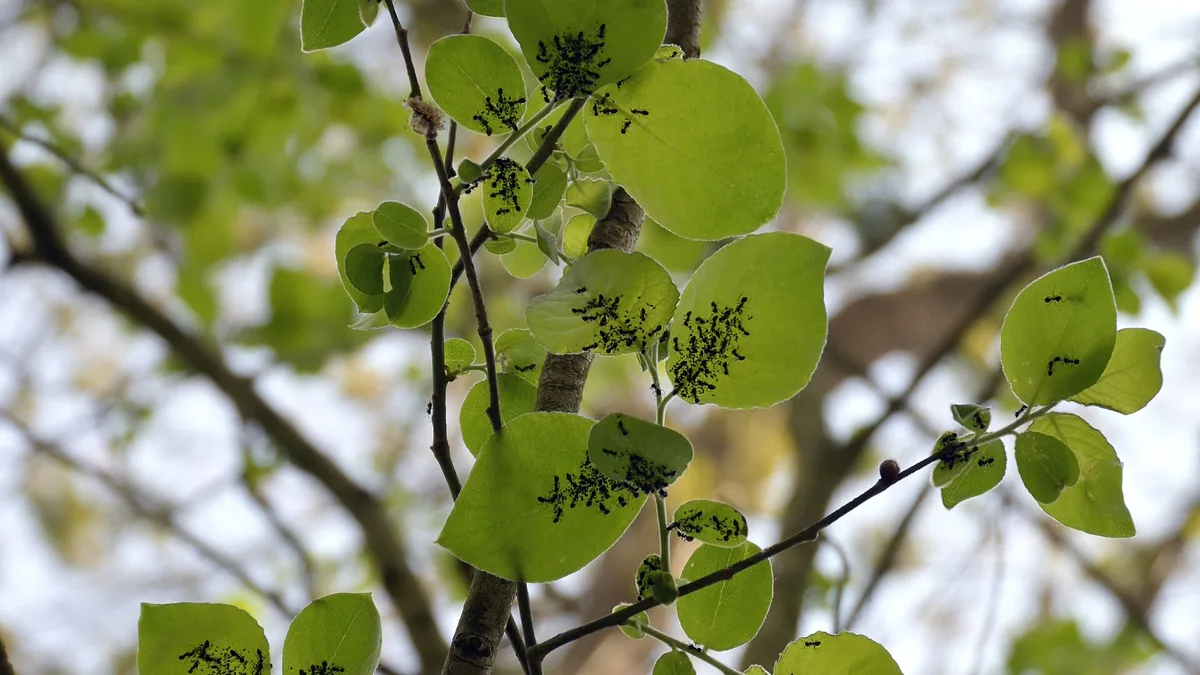
Aphids
| Country of origin | Worldwide distribution |
|---|---|
| First documented | Ancient times (18th century formal description) |
| Original use | Not applicable (wild insect pest) |
| Active months | Spring to autumn (peak in late spring/early summer) |
| Primary damage | Sap feeding, causing leaf curl and stunted growth |
| Common signs | Sticky honeydew residue, presence of ants, sooty mold |
| Typical hosts | Wide range, including roses, beans, brassicas, fruit trees |
| Control window | At first sighting, before populations explode |
Origin and history
Aphids are not a cultivated plant or crop but are small sap-sucking insects belonging to the superfamily Aphidoidea. Their evolutionary history dates back millions of years, with fossil evidence indicating their presence since at least the Triassic period. They are believed to have originated in temperate regions, with a center of diversity likely in the Northern Hemisphere. These insects have co-evolved with a vast range of host plants over geological timescales. Their documented history in human agriculture is ancient, with references to damaging infestations found in early agricultural texts. They are a naturally occurring group of insects, not selectively bred by humans.
What it was bred for
Aphids are not a bred organism in the agricultural sense; they are wild insects. They have not been selectively bred for human purposes, as their primary role from a human perspective is that of a pest. Some species have been used in limited scientific research, particularly in studies of symbiosis, reproduction, and plant-virus interactions. In a laboratory context, certain aphid lineages are maintained to study insect biology and to test pest control methods. Their rapid reproduction and clonal capabilities make them subjects for genetic and evolutionary studies. No commercial breeding programs exist for beneficial aphid production.
Life cycle
The aphid life cycle is complex and often involves both sexual and asexual reproduction phases, varying by species and climate. In temperate regions, overwintering eggs hatch in spring into wingless females called fundatrices, which reproduce asexually (parthenogenesis) to produce live nymphs. These nymphs mature quickly and continue parthenogenetic reproduction, leading to rapid population explosions. As crowding occurs or host plant quality declines, winged generations are produced to colonize new plants. In autumn, decreasing day length triggers the production of sexual males and females, which mate and lay overwintering eggs. In warmer climates or on perennial hosts, asexual reproduction may continue year-round without an egg stage.
Character and appearance
Aphids are small, soft-bodied insects, typically ranging from 1 to 7 millimeters in length. They exhibit a wide variety of colors including green, black, brown, yellow, pink, or red, often correlating with their host plant. Their bodies are pear-shaped with long, slender legs and antennae. Most species possess a pair of tubular structures called cornicles (or siphunculi) protruding from the rear of the abdomen, which secrete defensive fluids. Winged forms have two pairs of transparent, membranous wings, with the forewings larger than the hindwings. Nymphs resemble smaller, wingless versions of the adults, progressing through several instars before maturation.
How to grow Aphids
Aphids are not intentionally grown as a crop; they are pests that infest plants. To control or study them, one might introduce a few individuals onto a susceptible host plant, such as a young broad bean or nasturtium, under contained conditions. The host plant must be succulent and actively growing to provide the necessary sap nutrients. Maintaining moderate temperatures (around 20-25°C) and avoiding natural predators like ladybirds or lacewings will encourage rapid population growth. High nitrogen levels in the plant tissue, often from over-fertilization, can increase aphid fecundity. Regular monitoring is required as populations can overwhelm and kill the host plant quickly.
How long does Aphids take to grow
From birth to reproductive maturity, aphids develop very rapidly under favorable conditions. Nymphs typically undergo four molts over a period of about 7 to 10 days before becoming adult. This generation time is highly temperature-dependent, with development accelerating in warmer weather. A single female can begin producing live nymphs within a day of reaching adulthood. Under ideal summer conditions, a full generation from birth to the birth of the next generation can be completed in as little as one week. This exponential growth rate allows populations to escalate from a few individuals to a dense infestation in a matter of weeks.
Overview
Aphids are a large group of small, sap-sucking insects that infest a vast array of cultivated and wild plants. They are considered major agricultural and horticultural pests due to their direct feeding damage and role as vectors for numerous plant viruses. Their ability to reproduce both sexually and asexually, combined with a short generation time, makes them formidable and rapidly adapting opponents. Management typically involves an integrated approach combining cultural controls, biological control via natural enemies, and selective insecticide use. They form symbiotic relationships with bacteria that provide essential amino acids, allowing them to thrive on nutrient-poor plant sap. Their presence often indicates an imbalance in the garden ecosystem.
What to know
Aphids excrete a sugary waste product called honeydew, which can coat leaves and promote the growth of sooty mold fungi. Ants often protect aphid colonies from predators in order to harvest this honeydew, complicating control efforts. Many aphid species are host-specific, feeding on only one plant genus, while others are generalists. Their feeding causes leaf curling, stunting, and distortion of new growth, which can be mistaken for herbicide damage or disease. Monitoring should focus on the undersides of leaves and tender new shoots, where colonies typically establish. Natural predators like ladybird beetles, lacewing larvae, hoverfly larvae, and parasitic wasps are crucial for sustainable control.
Pros and cons
Pros: In a highly controlled ecological context, aphids can serve as a vital food source for beneficial insect populations, supporting garden biodiversity. They are excellent model organisms for scientific study due to their unique reproductive biology and symbiotic relationships. Their presence can act as an early indicator of overly succulent, nitrogen-rich plant growth, signaling a need to adjust fertilization practices. For entomologists and educators, they provide a readily accessible subject for observing insect life cycles and population dynamics. Cons: Uncontrolled infestations severely weaken plants, reducing crop yields and ornamental value. Their role in transmitting plant viruses, such as cucumber mosaic virus and potato virus Y, often causes more damage than their feeding alone. A common mistake is reaching for broad-spectrum insecticides first, which devastate natural predator populations and can lead to worse, resurgent infestations. Gardeners who rely solely on chemical control often regret it, as it disrupts ecological balance and can induce pesticide resistance. Their sticky honeydew production creates a secondary mess and fosters fungal diseases.
Who it suits
Aphids suit researchers and students in entomology or plant pathology who require a simple-to-rear insect for laboratory studies. They are relevant to commercial growers and gardeners who need to understand pest life cycles to implement effective Integrated Pest Management (IPM) strategies. Biological control producers who rear beneficial insects like ladybirds or parasitic wasps require aphids as a host food source for their product. They are decidedly unsuited for any gardener or farmer seeking healthy, productive plants without a dedicated and informed management plan. Their presence is inevitable in most growing systems, but their management is a task for the vigilant and ecologically-minded practitioner.