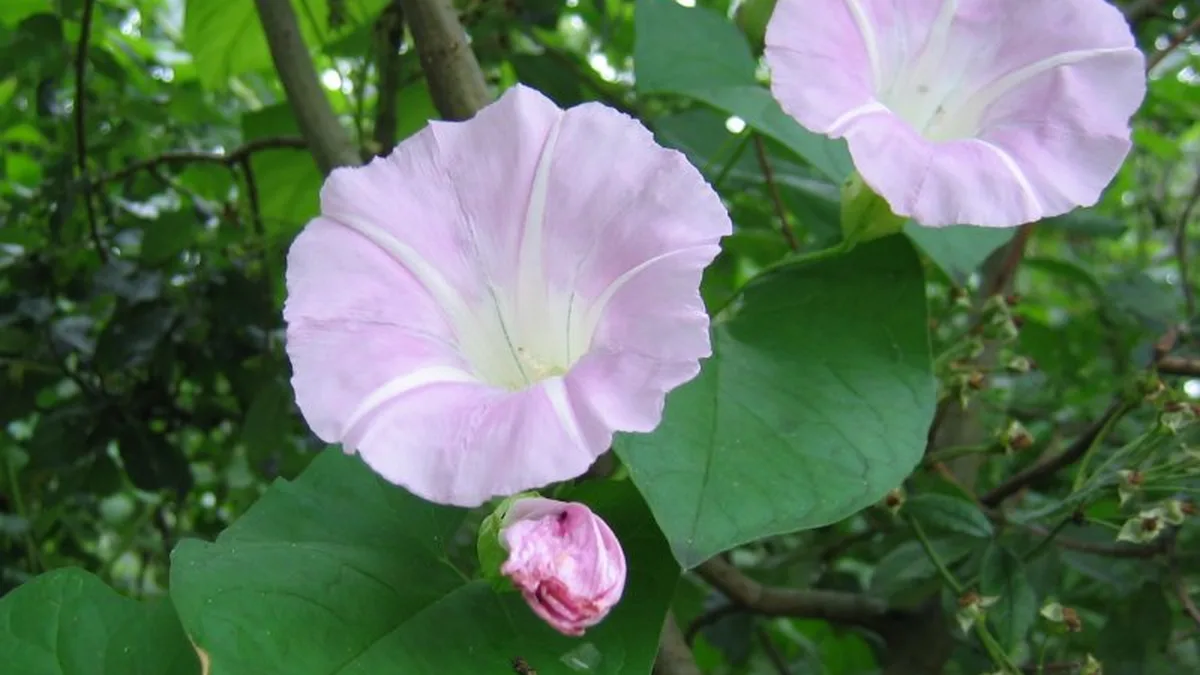
Bindweed
| Common name | Bindweed |
|---|---|
| Botanical genus | Convolvulus |
| Type | Perennial climbing or trailing vine |
| Control difficulty | High (invasive, persistent rhizomes) |
| Primary method of spread | Rhizomes and seeds |
| Flowering period | Summer to early autumn |
| Typical habitats | Gardens, cultivated land, waste ground, hedgerows |
| Legal status in many regions | Controlled weed (check local regulations) |
Origin and history
Bindweed is a common name primarily referring to plants in the Convolvulus and Calystegia genera, native to Europe and Asia. Its presence has been documented in these regions for many centuries, with records appearing in ancient herbals and botanical texts. The plant was not commercially bred but spread naturally and through human activity, often as an incidental introduction. It became widely established in North America following European colonization, where it is now considered an invasive species. Historical uses were primarily medicinal, with various species employed in folk remedies. Its tenacious nature has made it a persistent subject in agricultural writing since at least the 18th century.
What it was bred for
Bindweed was not intentionally bred for horticultural or agricultural traits. Unlike cultivated crops, it is a wild plant that has evolved naturally for survival and propagation in disturbed soils. Its vigorous growth habit and extensive rhizome system are natural adaptations, not the result of selective human breeding. Some ornamental species within the Convolvulus genus, such as Convolvulus sabatius, have been selected for garden use, but these are distinct from the weedy bindweeds. The common field bindweed (Convolvulus arvensis) spread as a contaminant in crop seed and soil. Its "purpose" from a human perspective is largely negative, as it competes aggressively with desired plants.
Life cycle
Bindweed is a perennial plant with a life cycle that persists for multiple years from a deep, extensive root system. It propagates both by seed and vegetatively through its creeping roots and rhizomes, which can fragment and generate new plants. Seeds can remain viable in the soil for several decades, germinating when conditions of light and temperature are favorable. Established plants emerge in spring, using stored energy from their root systems to produce vigorous climbing stems. Flowering occurs from late spring through autumn, producing new seeds continuously throughout the growing season. The plant dies back to ground level with the first hard frost, but the root system survives underground to regenerate the following spring.
Character and appearance
Bindweed is characterized by slender, twining or trailing stems that can grow over two meters in length, climbing over other vegetation or spreading along the ground. The leaves are typically arrowhead-shaped or triangular, with a distinct pair of backward-pointing lobes at the base. Its flowers are trumpet-shaped, usually white or pink with white stripes, and measure roughly 2-3 centimeters across. The root system consists of both vertical taproots that can penetrate several meters deep and horizontal rhizomes that form a dense network. A single plant can cover a significant area, forming a dense mat that smothers underlying plants. The overall appearance is deceptively delicate, belying its aggressive and resilient nature.
How to grow Bindweed
Growers do not typically cultivate common bindweed intentionally, as it is a problematic weed, but understanding its growth requirements explains its persistence. It thrives in full sun but will tolerate partial shade, growing in a wide range of soil types from clay to sand. The plant requires little to no fertility input and is highly drought-tolerant once established due to its deep root system. Control, rather than cultivation, is the standard approach, involving persistent digging to remove all root fragments or the use of systemic herbicides applied during active growth. Smothering with thick, light-blocking mulches for multiple seasons can also suppress it. Any cultivation that fragments the roots, such as tilling, will typically propagate the plant rather than control it.
When to plant Bindweed
Bindweed is not planted by gardeners or farmers; its emergence is dictated by environmental conditions. Seeds germinate in spring when soil temperatures reach approximately 15-20 degrees Celsius, typically from mid-April onwards in temperate climates. Established plants also emerge from overwintering root stocks in early to mid-spring as the soil warms. In mild climates, new growth can appear whenever temperatures are sufficiently warm, even during winter thaws. The plant's seasonal cycle is fixed, with no human intervention needed for planting. Attempting to plant it serves no agricultural or horticultural purpose, and its introduction is strongly discouraged due to its invasive character.
How long does Bindweed take to grow
From seed, bindweed seedlings establish a root system relatively quickly, but flowering and significant spread may take a full growing season. However, growth from existing root fragments is rapid, with shoots appearing within days and elongating several centimeters per day under ideal conditions. A plant can cover a square meter of ground or climb to the top of a fence within a single month during peak summer growth. The time to reach maturity from seed is variable, but the plant will typically flower in its first year. The deep root system develops over years, making established infestations increasingly difficult to eradicate. Continuous growth occurs until halted by frost, with the plant effectively never stopping its expansion during the growing season.
Pros and cons
The sole "pro" for common bindweed is its value as a nectar source for some pollinators, including moths, during its long flowering period. The overwhelming cons are its aggressive, invasive nature and profound negative impact on gardens and agriculture. It competes fiercely for water, nutrients, and light, often stunting or killing desired plants by smothering them. Its root system is incredibly resilient, with even small fragments left in the soil regenerating into new plants. Common mistakes include incomplete removal of roots through casual digging or using non-systemic herbicides that only burn back the top growth, which strengthens the plant. Most gardeners who have it deeply regret its presence, as eradication requires a persistent, multi-year effort.
Who it suits
Bindweed does not suit any intentional planting scheme in gardens or farms due to its invasive characteristics. It is sometimes tolerated on neglected land, roadsides, or waste ground where its growth does not conflict with other plants. Its tenacity might be of academic interest to botanists or ecologists studying invasive species dynamics. No responsible gardener or farmer seeks to cultivate common field or hedge bindweed. In contrast, some non-invasive ornamental species within the broader Convolvulus genus, like Convolvulus cneorum, are suitable for well-drained garden borders. The common bindweed suits only situations where plant competition is irrelevant and where its unchecked spread is acceptable.