Blight
| Common name | Blight |
|---|---|
| First documented | 18th century |
| Original use | Descriptor for plant diseases causing rapid wilting and death |
| Primary symptom | Rapid browning, spotting, and decay of leaves, stems, or fruit |
| Typical cause | Fungal or oomycete pathogens |
| Commonly affects | Potatoes, tomatoes, other solanaceous crops |
| Key management | Remove and destroy infected material, apply preventative fungicides, use resistant varieties |
Origin and history
Blight is not a single plant or crop but a term for a range of destructive plant diseases. The most historically significant forms are late blight, caused by the oomycete *Phytophthora infestans*, and early blight, caused by the fungus *Alternaria solani*. Late blight originated in the central highlands of Mexico, where it co-evolved with wild potato species. The disease achieved global notoriety in the 1840s when it spread to Europe and triggered the Irish Potato Famine. Its emergence as a major agricultural pathogen is therefore documented from the mid-19th century onward. Early blight also has a long history of affecting solanaceous crops but does not share the same specific point of origin narrative.
What it was bred for
Blight pathogens were not bred; they are naturally occurring organisms that evolved for survival and propagation. Their biological "purpose" is to infect host plants, deriving nutrients from living tissue and producing spores for dispersal. The rapid evolution of new strains is driven by natural selection pressures, not human breeding objectives. Some strains have developed resistance to specific fungicides, complicating control efforts. Research into blight pathogens focuses on understanding their life cycle to develop resistant plant varieties and effective treatments. The term "bred for" is fundamentally inapplicable to these disease agents.
Life cycle
The life cycle of late blight involves both asexual and sexual reproduction, depending on environmental conditions and strain types. Asexual reproduction occurs via sporangia, which can either germinate directly or release motile zoospores in free water. These spores require high humidity and cool to moderate temperatures to infect plant tissues, penetrating leaves, stems, or tubers. Sexual reproduction produces thick-walled oospores that can survive in soil and plant debris for extended periods, serving as a long-term survival structure. Early blight follows a simpler cycle, primarily producing conidia (asexual spores) on infected debris that are splashed by rain or wind onto new plants. Both pathogens rely on specific moisture and temperature windows to complete their infection cycles.
Character and appearance
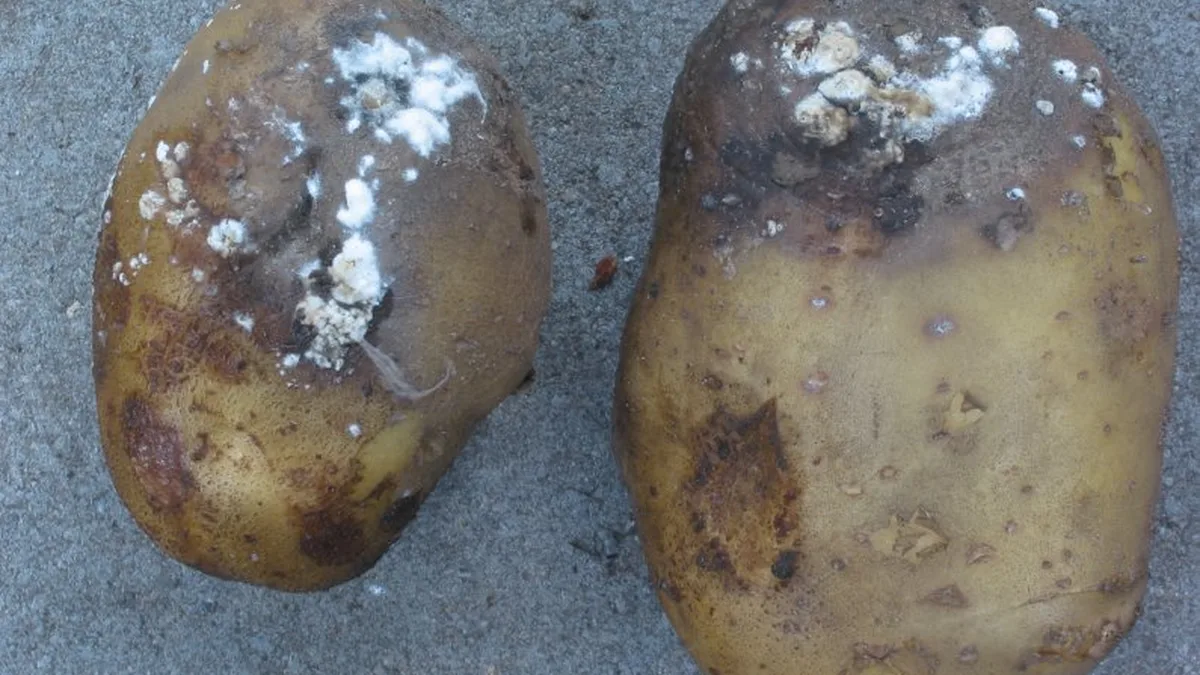
Late blight initially appears as small, pale green or water-soaked lesions on leaves, often beginning at leaf tips or edges. These lesions rapidly expand into large, dark brown or black necrotic patches, with a characteristic pale green or chlorotic border on the underside of leaves. During humid conditions, a fuzzy white fungal growth (sporulation) appears at the lesion margins. Infected potato tubers develop a firm, brownish-red dry rot that extends from the surface inward. Early blight presents as concentric, target-like dark brown spots with yellow halos on older leaves first. Stem lesions on both potatoes and tomatoes are also common and can lead to girdling and plant collapse.
How long does Blight take to grow
The growth and infection cycle of blight pathogens is extremely rapid under conducive conditions. For late blight, the time from spore deposition to the appearance of visible lesions can be as short as three to five days. Once a primary lesion is established, it can produce new spores within a single day, leading to exponential spread throughout a field. An entire field can be devastated in one to two weeks if cool, wet weather persists. Early blight development is generally slower, often taking one to two weeks for lesions to become fully apparent and sporulate. The speed of epidemic development is wholly dependent on sustained periods of leaf wetness and optimal temperature ranges.
Overview
Blight refers to several severe fungal and oomycete diseases that cause rapid plant necrosis and crop loss. The two most agriculturally significant are late blight of potato and tomato, and early blight of the same crops. These diseases are responsible for substantial economic losses globally and require vigilant management. Control strategies historically relied on protective fungicide applications, but integrated pest management is now essential. This integration includes the use of resistant cultivars, crop rotation, sanitation, and careful monitoring of weather conditions. Understanding the distinct pathogens and their environmental triggers is critical for effective prevention.
What to know
Blight is not a single entity, and correct identification of late blight versus early blight is crucial for management. Late blight is a community-scale threat, as spores can travel miles on wind currents, requiring area-wide alerts and coordinated action. Prevention is vastly more effective than cure; once symptoms are widespread, control is often impossible. Fungicide programs must be preventative and applied prior to infection when disease-favorable weather is forecast. All potato and tomato volunteers and cull piles must be destroyed, as they serve as overwintering reservoirs. Total removal and destruction of infected plant material is mandatory to reduce inoculum for subsequent seasons.
Common questions
A common question is whether blight can be treated with organic fungicides like copper sprays. Copper-based products offer some protective control but are not curative and can accumulate in soil to toxic levels. Gardeners often ask if tomato and potato blight are the same disease, and while late blight affects both, the strains can have host preferences. Many wonder if blight survives winter; late blight survives in infected tubers left in the ground or in compost piles, while early blight survives on plant debris. A frequent query is about eating produce from infected plants; tubers with late blight rot are inedible, while unaffected fruits from infected plants may be harvested but not stored. People also ask about resistant varieties, which exist but often trade off resistance for other traits like flavor or yield.
Pros and cons
This section is inapplicable to a plant disease. Blight pathogens offer no "pros" from a cultivation perspective; they are unequivocally detrimental agents. The "cons" are extensive: complete crop loss, high costs of control, the necessity for rigorous sanitation, and the rapid development of pathogen resistance to fungicides. A common mistake is delaying fungicide application until symptoms are seen, which is always too late. Gardeners often regret planting susceptible heirloom varieties without a robust protective plan during wet seasons. The disease forces a reactive rather than proactive gardening approach and can demoralize growers after seasons of careful work are destroyed in days.
Who it suits
This section is inapplicable to a plant disease. Blight suits no grower or gardener. The question of "suitability" is instead directed toward management strategies. Vigilant, detail-oriented growers who commit to preventative measures and regular scouting are best equipped to manage blight risk. It suits operations with the resources for approved fungicides and the discipline for strict sanitation practices. Conversely, it thoroughly unsuits casual gardeners who cannot monitor weather forecasts or inspect plants daily during high-risk periods. Those unwilling to destroy infected plants immediately or who save their own seed from susceptible varieties will face recurrent, severe problems.