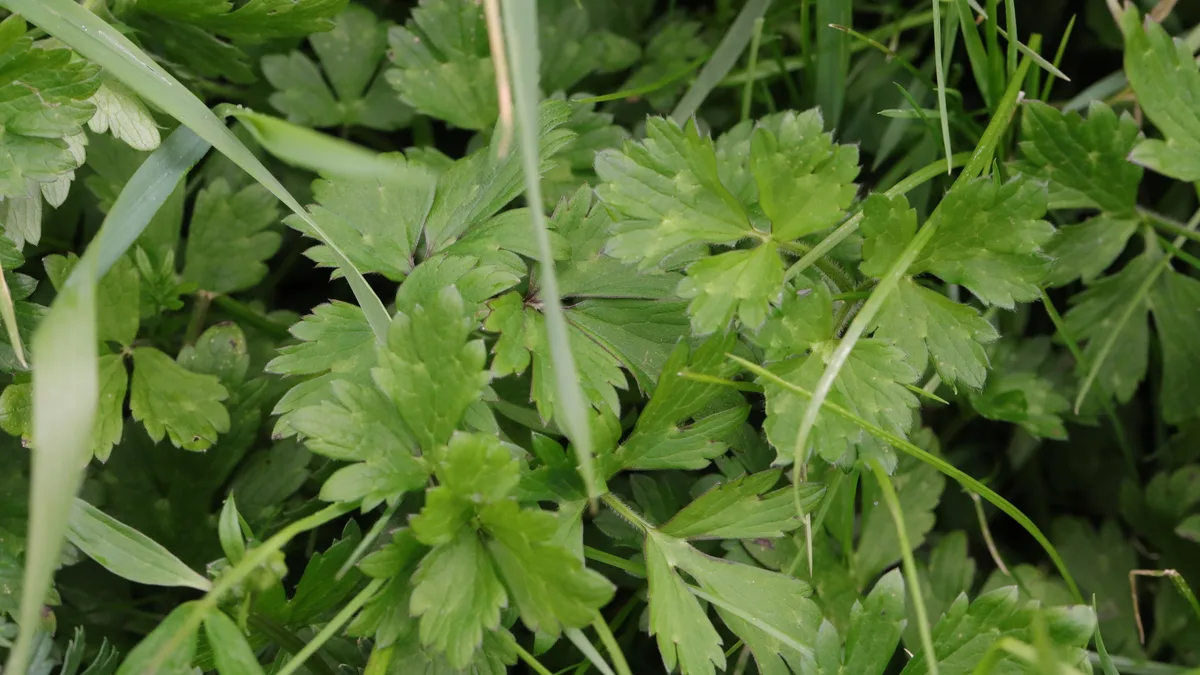
Creeping Buttercup
| Common name | Creeping Buttercup |
|---|---|
| Botanical name | Ranunculus repens |
| Country of origin | Europe, Western Asia, Northern Africa |
| First documented | Ancient times (widely documented in pre-Linnaean herbals) |
| Original use | Wild plant, not bred for gardens; considered a weed in cultivation |
| Month for primary control | May to September |
| Position | Full sun to partial shade |
| Soil | Moist, poorly-drained soils |
| Spread | Rapid, via rooting runners (stolons) |
Origin and history
Creeping Buttercup (Ranunculus repens) is a perennial flowering plant native to Europe, temperate Asia, and northwestern Africa. It has been a documented component of these regional floras for many centuries, with formal botanical descriptions solidified by the 18th century. The plant was not created or bred but evolved naturally in damp grasslands, meadows, and woodland edges. Its history is intertwined with its spread as a common weed, particularly following European colonization and the expansion of agriculture. It was likely introduced to North America and other parts of the world inadvertently through contaminated soil, ship ballast, or as an ornamental plant in the 19th century. Its tenacious growth habit ensured its establishment as a widespread naturalized and invasive species in many temperate regions globally.
What it is designed for
Creeping Buttercup is not designed by humans but is biologically adapted for rapid vegetative colonization of moist, open ground. Its primary purpose in an ecological context is to efficiently cover soil, outcompete other low-growing vegetation, and produce seeds for dispersal. The plant's physiology is designed for survival through an extensive network of creeping stolons that root at nodes, forming dense mats. This growth effectively shades out competitors and secures soil moisture for itself. Its bright yellow flowers are designed to attract pollinating insects, ensuring sexual reproduction and genetic diversity. In a managed garden context, it is not intentionally planted for a purpose but is typically regarded as an invasive weed that infests lawns, borders, and damp vegetable patches.
Development and versions
There are no cultivated versions or bred cultivars of Creeping Buttercup developed for garden use, as it is universally considered a problematic weed. The plant itself has developed, through natural selection, several key adaptations that contribute to its success. These include its resilient stolon system, which allows a single plant to spread over several square meters in a single growing season. It has also developed a high tolerance for compacted and waterlogged soils where other plants struggle. The plant produces both seeds and spreads vegetatively, a dual strategy that ensures propagation even if one method fails. While there are other species within the Ranunculus genus, such as the Persian Buttercup which is bred for ornamental use, Ranunculus repens remains genetically consistent as a wild type. Its "development" is best understood as its evolutionary adaptation to disturbed, damp habitats.
Pros and cons
A significant pro of Creeping Buttercup, from an ecological resilience perspective, is its ability to stabilize damp, bare soil quickly and provide early-season nectar for some pollinators. The primary and overwhelming con is its aggressively invasive nature in gardens, where it forms dense mats that choke out desired grasses, perennials, and ground covers. Common mistakes include mistakenly tolerating it for its cheerful flowers or assuming it can be easily controlled by hand-pulling alone. Gardeners often regret choosing to ignore initial patches, as the plant's stolons break easily, leaving rooted nodes in the soil that rapidly generate new plants. It thrives in poorly drained lawns, indicating underlying soil problems like compaction or poor aeration. Furthermore, all parts of the plant are toxic to humans and animals if ingested, causing irritation and digestive issues, which is a liability in gardens accessible to pets or livestock.
Who it suits
Creeping Buttercup suits only specific, unmanaged ecological niches, such as wild bog gardens or very damp meadows where its invasive tendencies are not a concern. It may be tolerated in large, informal wildlife areas where soil stabilization in wet spots is the sole priority. It does not suit any formal ornamental garden, manicured lawn, vegetable plot, or perennial border due to its uncontrollable spread. The plant particularly suits, or rather exploits, gardens with persistent drainage issues, heavy clay soil, and areas of shallow compaction. It is utterly unsuited for gardeners seeking a low-maintenance lawn alternative, as it will rapidly become the dominant species. Only those with a dedicated naturalistic planting scheme, who understand and accept its vigorous behavior, might consider it, but even then, its introduction is generally discouraged.