Runner Beans
| Country of origin | Central and South America |
|---|---|
| First documented | Pre-Columbian era (cultivated for millennia) |
| Original use | Food crop (pods and dried beans) |
| Sow outdoors | After last frost, from late spring to early summer |
| Harvest | Mid-summer to early autumn |
| Position | Full sun |
| Soil | Fertile, moisture-retentive, well-drained |
| Spacing | 15-20 cm apart in rows 45-75 cm apart |
| Support required | Yes, tall climbing variety |
Origin and history
Runner beans (*Phaseolus coccineus*) originate from the highland regions of Central America, specifically areas of modern-day Mexico and Guatemala. They were cultivated by indigenous peoples for centuries before European contact, with archaeological evidence suggesting domestication over two thousand years ago. Unlike their common bean relatives (*Phaseolus vulgaris*), runner beans were initially valued more for their attractive flowers and durable seeds than for their immature pods. They were introduced to Europe in the 17th century, primarily as an ornamental climbing plant for gardens. Their culinary use as a green pod vegetable became more widespread in European kitchen gardens during the 18th and 19th centuries. The plant's tolerance for cooler, wetter summers than common beans aided its adoption in Northern European climates, particularly in the United Kingdom.
What it was bred for
Historically, runner beans were primarily bred for their prolific production of striking scarlet flowers, making them a popular ornamental vine. Early selection focused on enhancing the plant's vigorous climbing habit and its showy floral displays, which attract pollinators like hummingbirds and bees. Over time, breeding efforts shifted towards improving the culinary qualities of the long, green pods, aiming to reduce stringiness and parchment development in the pod walls. Modern cultivars have been developed for heavier pod yields, more tender texture, and a longer harvesting period. Some breeding has also targeted pod colour, producing varieties with white, pink, or bicoloured flowers, though the classic scarlet remains dominant. Additionally, selection has worked to enhance the plant's tolerance to cooler temperatures, allowing for successful cultivation in regions with less intense summer heat.
Life cycle
Runner beans are tender perennial plants, but they are almost universally grown as annuals in temperate climates due to their susceptibility to frost. The life cycle begins with sowing a large, distinctive seed after the last frost in spring, as germination requires warm soil temperatures. The plant progresses through a rapid vegetative stage, producing vigorous climbing vines that can reach over two metres in height and require substantial support. Flowering typically commences in mid-summer, with pollination necessary for pod set, which can be poor in very hot, dry, or windy conditions. Following successful pollination, the flat, green pods develop quickly and are harvested continuously in a "pick-and-come-again" fashion throughout late summer and into early autumn. If pods are left unharvested, they mature to produce large, often beautifully patterned, dried beans, completing the annual cycle before the plant is killed by the first hard frost.
Character and appearance
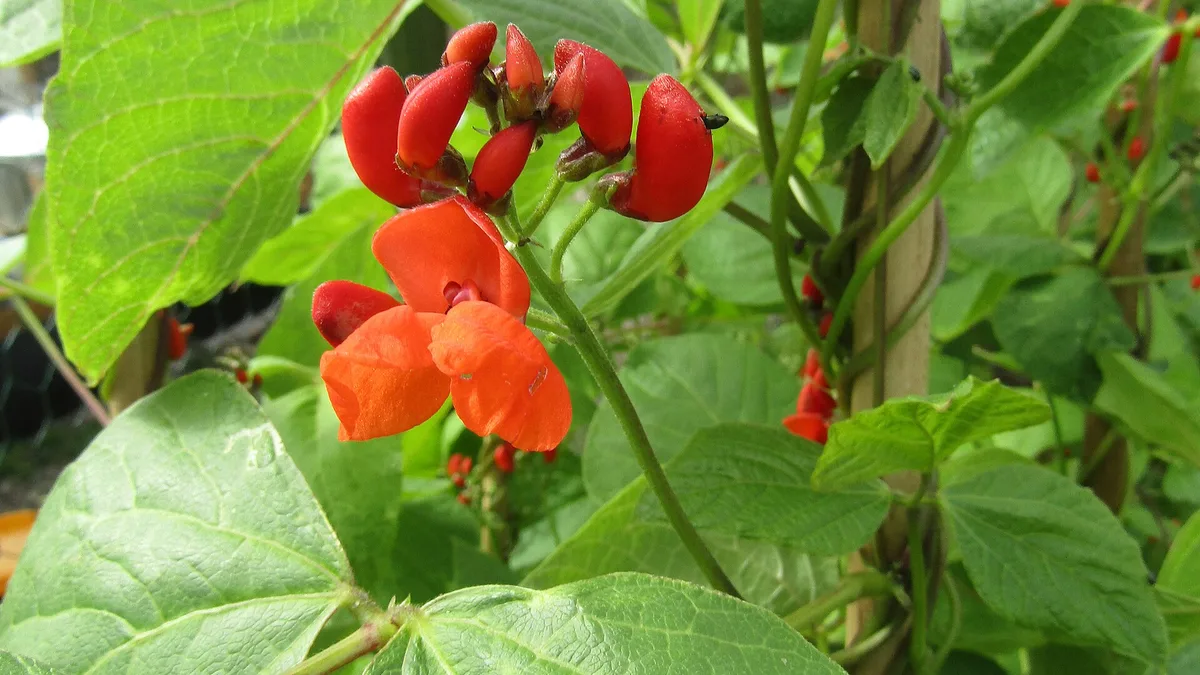
Runner beans are characterized by their exceptionally vigorous and fast-growing twining stems, which readily ascend poles, netting, or other supports. The leaves are broad, trifoliate, and a lush medium green, forming a dense canopy. The most visually distinctive feature is the clusters of brightly coloured flowers, most commonly a vibrant scarlet, which are rich in nectar and attract a variety of pollinators. The edible pods are long, flat, and slightly fuzzy when young, often growing to 20-30 centimetres in length and containing sizeable, plum-coloured seeds visible through the pod wall. The overall impression is of a robust, productive, and somewhat unruly climbing plant that creates a substantial vertical mass in the garden. Certain cultivars offer variations, such as white or salmon-pink flowers, or more restrained semi-dwarf habits for smaller spaces.
Pros and cons
A major pro is their high yield from a small footprint due to vertical growth, providing a plentiful harvest over many weeks. They are generally reliable croppers in cooler, damper summers where common French beans might fail. The vibrant flowers add ornamental value and support pollinators. A significant con is their absolute requirement for strong, tall support structures from the moment of planting, which demands more initial effort than bush beans. The plants are heavy feeders and drinkers, requiring consistently moist, fertile soil or else pod set suffers and pods become tough and stringy. Many gardeners regret choosing them in very hot, dry climates or small gardens without the space for their expansive growth, as they can easily overwhelm neighbouring plants. A common mistake is sowing too early into cold, wet soil, which leads to seed rot and poor establishment.
Who it suits
Runner beans suit gardeners with a medium to large vegetable plot who have the space to erect substantial climbing frames, such as traditional bean poles or large obelisks. They are ideal for growers in cooler, maritime climates, like those found in the UK and parts of Northern Europe, where their tolerance for damp summers is a distinct advantage. They suit patient gardeners who do not mind the initial work of building supports and preparing rich soil, in exchange for a long and abundant harvest. They are less suited to gardeners in arid regions without reliable irrigation, or those with very small, exposed plots where wind-rock can damage the tall vines. They are also a good choice for gardeners who wish to integrate productive plants with ornamental value, benefiting both the kitchen and local pollinator populations.