Garlic
| Country of origin | Central Asia |
|---|---|
| First documented | Ancient times (over 5000 years ago) |
| Original use | Culinary and medicinal herb |
| Planting time | Autumn or early spring |
| Harvest time | Mid to late summer |
| Position | Full sun |
| Soil | Well-drained, fertile |
| Hardiness | Fully hardy perennial |
Origin and history
Garlic is believed to have originated in the mountainous regions of Central Asia, specifically in an area encompassing modern-day Kyrgyzstan, Tajikistan, and parts of western China. Its use by humans is ancient, with documented cultivation dating back over 5,000 years. It was highly valued in ancient Egyptian, Babylonian, Greek, and Roman civilizations for both culinary and medicinal purposes. Garlic was introduced to the Mediterranean basin and subsequently spread throughout Europe and the rest of the world via trade routes and exploration. Its historical record is one of the most extensive among cultivated plants, frequently mentioned in classical texts and medical treatises. The plant's durability and pungent flavor made it a staple food for laborers and soldiers in antiquity.
What it was bred for
Garlic was primarily selected and bred for the size, pungency, and storage quality of its underground bulb, which is a cluster of individual cloves. Early cultivation focused on developing reliable cloves for vegetative propagation, as the plant rarely sets true seed. Over millennia, growers selected for traits like bulb wrapper color, clove size and number, and adaptation to different day lengths and climates. A key breeding goal was always the intensity of its signature sulfur-containing compounds, which provide both its flavor and its presumed health benefits. Unlike many modern vegetables, most garlic varieties are heirlooms, developed over centuries of clonal selection rather than recent scientific hybridization. The division into hardneck and softneck types represents a fundamental breeding divergence for climate adaptability and storage performance.
Life cycle
Garlic is grown from individual cloves, which are planted in the autumn or early spring depending on the type and local climate. The clove initiates root growth and may send up a green shoot before winter dormancy in colder regions. In spring, vegetative growth resumes rapidly, producing long, flat leaves that photosynthesize to fuel bulb development. Hardneck varieties produce a central flower stalk called a scape in early summer, which is often removed to direct energy to the bulb. The bulb enlarges beneath the soil as day length increases and temperatures warm, with each clove developing into a new bulb segment. The plant is harvested in mid-to-late summer when several of the lower leaves have turned brown, signaling that the bulbs have matured and the wrappers have dried.
Character and appearance
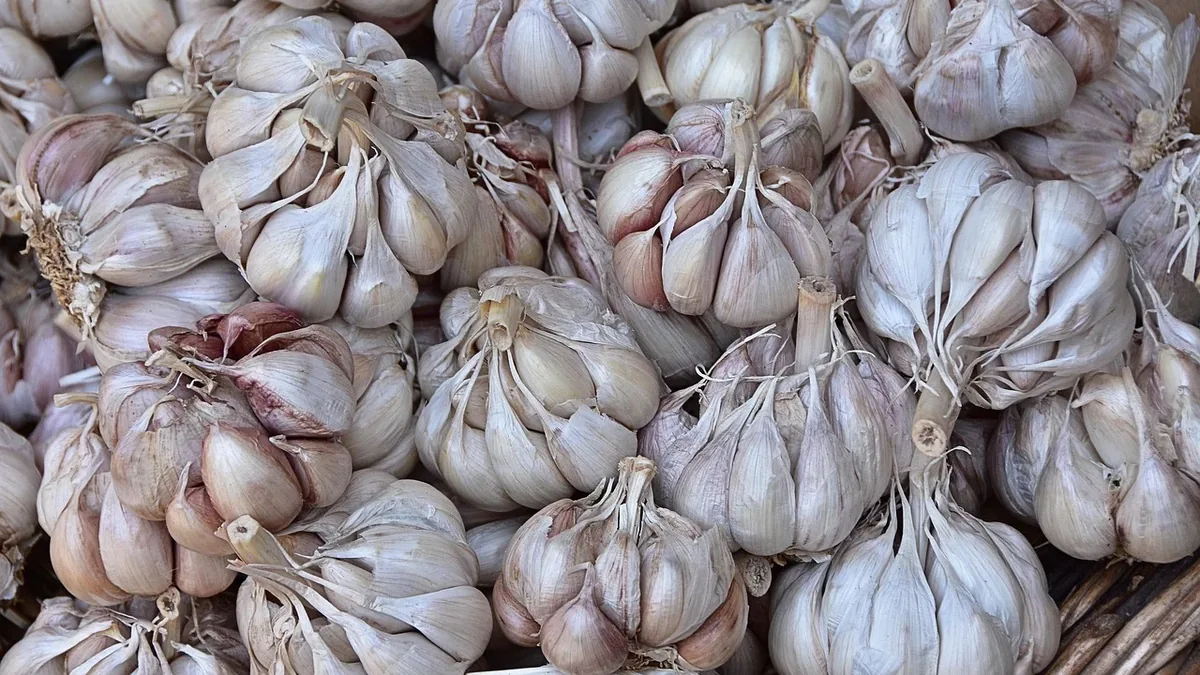
The garlic plant has upright, linear leaves that are flat and bluish-green, growing from a central base. Its most distinctive feature is the underground compound bulb, comprised of multiple cloves encased in papery, white to purple-tinged protective wrappers. Hardneck varieties produce a rigid, central flowering stalk that coils before straightening, while softnecks have pliable leaves suited for braiding. The entire plant emits a strong, pungent aroma when any part is bruised or cut. At maturity, the above-ground foliage dies back, leaving only the dried stalk or leaves attached to the harvested bulb. The cloves themselves are teardrop-shaped, with a firm texture and a pungent flavor that is released only when the cell walls are broken.
Pros and cons
A primary advantage of garlic is its exceptional storage life; properly cured hardneck varieties can last for months, and softnecks can store for up to a year under ideal conditions. It requires relatively little space in the garden and has few serious pest problems due to its natural compounds. The main con is its long growing season, occupying garden space for up to nine months for autumn-planted types, which can be a planning challenge. Gardeners in mild-winter regions often regret choosing hardneck varieties, which require a prolonged cold period to form proper bulbs and may perform poorly. A common mistake is harvesting too early, resulting in bulbs with poorly formed wrappers that will not store well, or too late, where the bulbs may have split open in the soil. Its vegetative propagation also means any soil-borne diseases, like white rot, can persist and accumulate in the planting area over successive seasons.
Who it suits
Garlic suits gardeners who have patience and plan their garden space for a long-term crop, as it requires minimal maintenance once planted. It is ideal for those interested in home storage crops and self-sufficiency, given its excellent keeping qualities. Cooks who value intense, fresh flavor and a range of varieties unavailable in supermarkets will benefit from growing their own. It is well-suited to gardeners in regions with distinct seasons, particularly those with cold winters that satisfy the vernalization requirement of hardneck types. Garlic is not well-suited to gardeners with very small, intensively planted plots that require rapid crop turnover, or those in consistently hot, humid climates where bulb formation can be inhibited and disease pressure is high. It also suits organic growers well, as it generally requires few chemical interventions.