Ground Elder
| Common name | Ground Elder |
|---|---|
| Botanical name | Aegopodium podagraria |
| Type | Herbaceous perennial |
| Status | Invasive weed |
| Original use | Medicinal herb |
| Control methods | Digging, smothering, repeated cutting |
| Flowering period | Late spring to summer |
| Position | Shade to partial shade |
| Soil | Moist, fertile |
Origin and history
Ground Elder, *Aegopodium podagraria*, is native to Europe and temperate regions of Asia. It has a long history of cultivation and use, dating back many centuries. The plant was documented in medieval European herbals for its medicinal applications. It was intentionally introduced to North America by European settlers in the early 19th century, primarily as a food and medicinal plant. Its common name derives from its historical use in treating gout, then known as "the gout of the elder," due to a perceived similarity in leaf shape. Unlike many modern crops, it was not commercially bred but spread through its utility and, later, its aggressive nature.
What it was bred for
Ground Elder was not selectively bred for ornamental or agricultural traits in a formal sense. Its propagation was driven by its perceived value as a pot herb and medicinal plant. Historically, it was cultivated in monastery gardens across Europe as a reliable source of early spring greens. The plant was valued for its anti-inflammatory properties and was used to make poultices for joint ailments like gout and arthritis. Its rapid growth and hardiness made it a practical choice for providing fresh greens when other vegetables were scarce. Over time, its deliberate cultivation ceased as its invasive potential became widely recognized, and it transitioned to being considered a persistent weed.
Life cycle
Ground Elder is a herbaceous perennial with a life cycle heavily dependent on its extensive rhizome system. It emerges early in spring, often in March or April, from overwintering rhizomes and quickly produces a canopy of leaves. Flowering typically occurs in late spring to early summer, producing small white umbels that can set seed, though seed propagation is less common. The plant's primary strategy is vegetative spread through aggressive, brittle, white rhizomes that can extend several meters from the parent plant. These rhizomes store energy and can remain dormant in the soil for extended periods. The foliage dies back completely in late autumn after the first hard frosts, but the rhizome network persists underground throughout the winter, ready to regrow the following spring.
Character and appearance
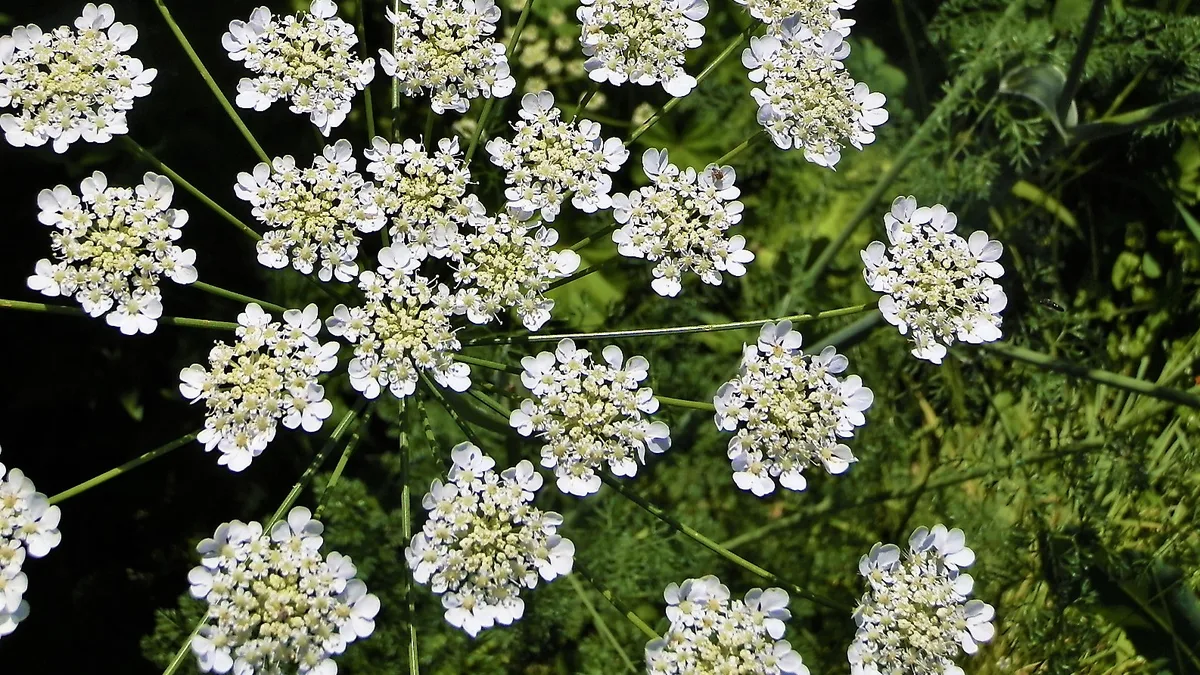
Ground Elder grows to a height of 30 to 100 centimeters, forming dense patches. Its leaves are compound, typically divided into three groups of three leaflets, with each leaflet being ovate and toothed, resembling a coarse parsley or elder leaf. The leaves are bright green and often slightly glossy. In late spring, it produces flat-topped clusters, or umbels, of small, white flowers atop erect stems. The flowers are reminiscent of other members of the carrot family, Apiaceae. The plant's most defining characteristic is not visible above ground: a matted network of white, creeping rhizomes just below the soil surface, which enable its rapid colonization of an area.
How to grow Ground Elder
It is strongly advised not to intentionally cultivate Ground Elder due to its highly invasive nature in gardens and natural areas. If one insists on growing it for historical or educational purposes, it should be confined within a solid, subterranean barrier that extends at least 50 centimeters deep to prevent rhizome escape. Plant rhizome sections in a moist, fertile, partially shaded area, which it prefers. It requires no fertilization and is exceptionally drought-tolerant once established. Control measures for unwanted growth are far more common and involve persistent, careful digging to remove all rhizome fragments, or the use of systemic herbicides applied to the foliage, often requiring multiple applications over several seasons.
When to plant Ground Elder
Given its status as a pernicious weed, there is no recommended planting time for Ground Elder. Historically, rhizome sections would have been planted in either early spring or autumn when the soil is workable. These times coincide with periods of active root growth, allowing it to establish quickly. Any planting activity should be preceded by the installation of a deep, impenetrable root barrier. For gardeners, the focus is overwhelmingly on eradication, with removal efforts being most effective in spring when the soil is moist and the rhizomes are easier to extract, or in late summer when herbicide applications are most effective as the plant transports nutrients to its roots.
How long does Ground Elder take to grow
Ground Elder establishes with alarming speed from rhizome fragments. New shoots can emerge within a week or two of planting a rhizome section in suitable conditions. A small patch can expand radially by several tens of centimeters in a single growing season through its vigorous rhizomes. Complete ground cover can be achieved within two to three years if left unchecked. The plant grows rapidly in the spring, often outpacing desirable garden plants. From a gardening perspective, the more relevant timeline is the duration of eradication efforts, which typically require persistent control measures over three to five years to exhaust the energy reserves in the rhizome network.
Pros and cons
The primary pro is its historical use as an early spring edible green, with a flavor similar to parsley or celery, and its traditional medicinal applications. It is an extremely hardy plant that can thrive in deep shade and poor soils where little else will grow, providing quick ground cover. The significant cons overwhelmingly dominate; it is one of the most notoriously invasive garden weeds in temperate climates. Its rhizomes are brittle, snapping easily when dug, leaving fragments that each regenerate into new plants, making complete eradication extremely difficult. Gardeners who inherit it often regret its presence, as it smothers herbaceous borders, lawns, and vegetable plots. The common mistake is underestimating its tenacity and attempting half-hearted removal, which only worsens the infestation.
Who it suits
Ground Elder suits absolutely no one for intentional cultivation in a standard garden setting. It may be of interest to historical reenactors or ethnobotanists studying traditional uses of plants, provided it is grown under strict containment. It could theoretically be used in a controlled, large-scale permaculture system as a perennial ground cover and forage plant on land where its spread is irrelevant or even desired. For the vast majority of gardeners and land managers, it is a plant to be vigorously controlled and removed, not welcomed. Its aggressive nature makes it entirely unsuitable for mixed planting beds, ornamental gardens, or anywhere near cultivated land.
Latest Ground Elder news
Latest reporting
Ground-Cover Garden in Hartford, Wisconsin
Diane's garden features a low carpet of ground cover along a walkway, with stepping stones and a shaded corner featuring an old wagon wheel. The...
Ajuga Reptans: Shade-Friendly Ground Cover That Spreads Quickly
Ajuga reptans, or bugleweed, is a low-maintenance perennial that thrives in shade, grows to about 6 inches tall, and spreads via runners to cover...
A Simple Puddle Bird Bath Attracts Timid Ground-Dwelling Birds
Attracting timid ground-dwelling birds to your yard can be achieved with a simple puddle bird bath.